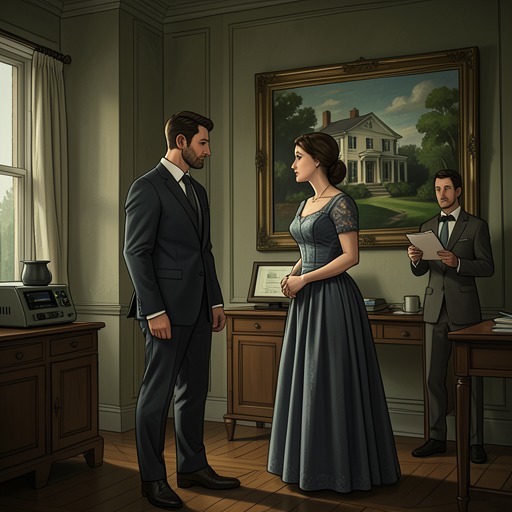
Kayla’s newspaper matchmaking advertisement
Call Me YoursKayla’s newspaper matchmaking advertisement is the plot’s initiating bridge between Kayla Renae Morrison and Chris Davis. It presents Kayla as a wealthy thirty-two-year-old woman seeking a male companion, but its insistence on correspondence by letter makes emotional access depend on written self-disclosure rather than immediate social performance. The advertisement therefore creates both the possibility of love and the conditions for the secrecy, projection, and delayed revelations that will define the relationship.
The Advertisement and Its Immediate Context
Kayla places the advertisement after repeated disappointment with conventional dating. She cannot determine why men leave after a first date and suspects that searching too closely into their problems might force her to confront an uncomfortable truth. The local-paper advertisement seems promising when she creates it, but by the time a new letter arrives she is no longer certain it was wise. Her uncertainty gives the advertisement a double function: it is an active attempt to change her life and an admission that ordinary romantic encounters have failed her.
The advertisement identifies its author as “KAYLA RENAE,” a thirty-two-year-old woman searching for a male companion who is interested only in communicating through exchanged letters. The restriction is significant because Kayla is a business tycoon and socialite whose public identity is inseparable from wealth and visibility. At the Vanessa Lauren Art Gallery, she appears in an expensive white business suit, diamond-embedded earrings, a sequined designer purse, and stilettos worth thousands of dollars. The advertisement offers a route around that conspicuous identity by asking suitors to meet her first through language.
For two weeks, hundreds of eligible bachelors from across the country answer the advertisement. Kayla rejects them because none seems to be the right person, while her wealth attracts men she regards as lazy or opportunistic. The abundance of responses does not lessen her loneliness; it sharpens the distinction between being desired as a fortune and being understood as a person. Her hope that a letter might be the one she has been waiting for remains guarded behind an aloof manner, which she uses to make her assistant believe that the incoming correspondence does not matter.
Chris Davis Finds the Notice
Chris Davis encounters the advertisement while working as a janitor at a Morrison Group of Hotels property. His back is already throbbing, his muscles jerk, and pain shoots down his back as he tries to empty a trash can. When a newspaper falls out, he picks it up to throw it away, but the bold notice on the front page catches his attention. The romance begins not in a glamorous meeting place but in discarded paper and physical discomfort, linking the possibility of love to Chris’s precarious working life.
The surroundings make Chris doubt that he could belong in Kayla’s world. The towering five-star hotel, its wealthy patrons, designer clothing, and jewelry suddenly become intimidating. He survives on less than a few dollars a day, and his janitorial salary is not enough to support a family, although obtaining the job at the prestigious Morrison hotel is the best thing that has happened to him. The advertisement consequently produces a rapid emotional reversal: excitement gives way to wobbling knees and self-doubt as Chris measures his poverty against Kayla’s affluence, yet a small hope remains strong enough to make him consider answering.
Chris’s response is later shaped by the personal history he discloses in the correspondence. He tells Kayla that he lost his parents in a car wreck at sixteen, an accident that left him with a back injury and a limp. He also describes his appearance as five feet five, with brown hair and brown eyes, and says that he is clean-shaven. His account presents vulnerability without reducing him to it. The advertisement has asked for a companion through letters, and Chris answers by supplying the kind of concrete truth that an in-person encounter might conceal beneath class anxiety or physical self-consciousness.
Letter Romance and Emotional Access
The advertisement establishes an epistolary courtship in which Kayla and Chris can disclose loneliness at a controlled distance. Chris’s letter tells Kayla that her words have made him laugh and cry, that he feels a deep connection with her, and that his own life has not been easy. He responds to her pain rather than merely to her social status, while his description of his injury gives her an understanding of the body and history behind the letter.
The correspondence also creates a shared future before the two have met. Chris says that he has always wanted a daughter and asks Kayla to tell him more about hers, including what she looks like and whether she resembles her mother. This interest draws Adi Morrison into the romance from its beginning. Kayla is not approached only as an isolated woman seeking companionship; she is addressed as a mother whose family life matters. The letter therefore reaches toward domestic belonging as well as romantic attachment.
Kayla’s handling of the incoming letter reveals how much the advertisement has already altered her emotional habits. When Jessica Cooper brings her an envelope and says, “You have a letter, ma’am,” Kayla casually instructs her to place it on the vanity, trying to appear indifferent. Yet she desperately wants the letter to be the one. The performance of detachment protects her from disappointment while confirming the advertisement’s power: written contact has become the object around which her anticipation and fear organize themselves.
Family, Class, and Hidden Identity
The advertisement’s apparent search for a male companion eventually intersects with a much larger crisis of identity. Kayla’s relationship with Adi is strained as Adi grows from an affectionate child into a rebellious teenager. Adi’s resentment is visible when Jessica rescues her after trouble and Adi says that she is glad Jessica came but does not need a lecture or an attempt to act as her mother. Kayla’s matchmaking project thus unfolds beside a fragile household whose relationships are already marked by concealment and disputed parenthood.
Later revelations recast the advertisement as part of the story’s concealed identity structure. Jessica explains that she discovered Jamie Cooper had an alter ego named Kayla Renae Morrison, a wealthy woman who owned hotel chains and a mansion. She also reveals that Adi was her daughter and that Kayla had accepted Adi as her own without remembering that Jessica had brought the child to her home. What initially looks like a straightforward personal advertisement is therefore connected to dissociative identity, blocked memory, and the unstable boundaries of family roles. The name printed in the newspaper is both a public identity and one expression of a hidden life.
The backstory deepens this instability through Jamie’s childhood. As a child, Jamie secretly wore dresses and discovered boxes of girls’ clothing that his mother had bought from infancy through age twelve, even though she insisted that boys could not wear dresses and required him to live as Jamie. After leaving home at eighteen, the persona later known as Kayla could present herself as a woman, learning makeup, feminine movement, and feminine speech. The advertisement’s polished female name thus carries a history of forced concealment and self-fashioning, making its promise of romantic recognition inseparable from the desire to be seen as the self one believes oneself to be.
Narrative Consequences and Significance
The advertisement changes the story’s value structure from isolation toward connection, but it does not remove the obstacles surrounding that connection. It gives Chris a reason to imagine love despite poverty, injury, and his belief that a man in his position should not expect a relationship with a wealthy woman. It gives Kayla a controlled form of intimacy after failed dates and unwanted attention from men attracted to her fortune. Their letters allow mutual recognition to begin before either person can fully confront the social and psychological identities involved.
At the same time, the advertisement creates a space in which partial self-presentations can appear sincere while remaining incomplete. Kayla receives hundreds of letters but cannot find the right man; Chris offers his injury, appearance, family loss, and hopes for fatherhood, yet the correspondence develops within a world where Kayla’s identity itself is unstable and hidden. The form promises honesty because letters permit confession, but it also postpones direct verification. That tension helps explain why the advertisement is more than a matchmaking device: it is the narrative mechanism through which love, class difference, disability, motherhood, gendered self-presentation, and repressed history become entangled.